

The 5th International Symposium on Business Simulation and Educational Innovation, held on November 27 and 28 at Universidad Hispanoamericana, dedicated one of its central sessions to a topic that continues to shape the direction of digital education: the benefits and challenges of gamification in learning.
The discussion focused on how gamified environments—especially those that integrate business simulators—are transforming motivation, autonomy, and competency development for students at all levels.
Before diving into the theory, it is worth highlighting the following key session of the symposium, which offered a comprehensive perspective from practice, research, and academic management.
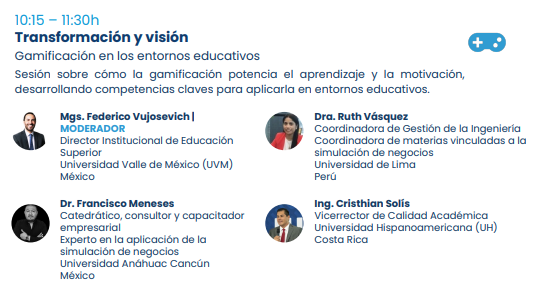
Transformation and Vision — Gamification in Educational Environments
This session brought together professionals from different countries who shared complementary perspectives on how to apply gamification to enhance learning and develop real-world competencies.
Participants:
- Mgs. Federico Vujosevich — Moderator. Institutional Director of Higher Education, Universidad Valle de México (UVM), Mexico.
- Dr. Ruth Vásquez — Coordinator of Engineering Management and professor responsible for subjects linked to business simulation, Universidad de Lima, Peru.
- Dr. Francisco Meneses — Professor, consultant, and corporate trainer. Expert in business simulation, Universidad Anáhuac Cancún, Mexico.
- Ing. Cristhian Solís — Vice-Rector of Academic Quality, Universidad Hispanoamericana (UH), Costa Rica.
During the session, participants explored use cases, implementation challenges, and strategies for integrating gamified experiences that truly impact student performance.
Gamification in Education: Key Insights, Benefits, and Emerging Challenges
Based on the symposium discussions, several theoretical elements and trends were highlighted that are shaping the current role of gamification in education.
Future Trends in Digital Education
Gamification is no longer limited to visual rewards or basic game-like elements. New trends include:
- AI-powered simulators, capable of adapting scenarios and difficulty levels to each student.
- Immersive narratives, where learning is embedded in missions, challenges, or storylines.
- Deep personalization, where learner decisions generate different paths.
- Gamified microlearning, ideal for specific competencies and short learning cycles.
These trends are driving more realistic, interactive experiences closely connected to real-world professional challenges.
The Importance of Business Simulators in Training
Experts agreed that business simulators play a central role in educational gamification because they allow learners to:
- Practice in environments that mirror real-world situations.
- Make decisions under pressure and analyze their outcomes.
- Develop transversal skills such as problem-solving, leadership, communication, and strategic thinking.
- Generate performance evidence, essential for modern assessment models.
At CompanyGame, we see this every day: a well-designed simulator turns learning into a meaningful and measurable experience.
Gamification and Student Autonomy
One of the most notable themes was how gamification enhances student autonomy:
- Learners become the main protagonists of the process.
- Exploration, trial, and safe error-making are encouraged.
- Motivation increases through progress and personal achievement.
- The teacher’s role evolves into that of guide, facilitator, and performance analyst.
Properly implemented, gamification fosters more active, self-regulated, and deeper learning.
Evaluating Different Gamification Modalities
The symposium also stressed the need to carefully evaluate how gamification is implemented. Among the most frequently discussed modalities:
- Points, badges, and leaderboards, effective for initial motivation.
- Progressive challenges, ideal for sustained engagement.
- Strategic simulations, essential for complex learning.
- Narrative-based scenarios, which strengthen decision-making and empathy.
- Collaborative gamification, valuable for teamwork and leadership skills.
The key is not simply using “games,” but selecting the modality that best aligns with learning objectives.
Gamification in Challenge-Based and Problem-Based Learning
Gamification fits particularly well with active methodologies such as:
- Challenge-Based Learning (CBL)
- Problem-Based Learning (PBL)
Within these approaches, gamification strengthens:
- Autonomous challenge resolution.
- Critical thinking.
- Constant experimentation.
- Consequence analysis.
- Iteration and continuous improvement.
Business simulators, by nature, are ideal tools for these methodologies.
Conclusion: A Clear Vision for the Future
The 5th Symposium delivered a strong message:
gamification is not a trend—it is a solid, evidence-based educational strategy with real impact on motivation and competency development.
The insights shared by the experts, together with the practical experiences presented, confirm that:
- Gamification will continue to grow.
- Business simulators will play a leading role.
- Educational institutions will increasingly need to adopt these methodologies strategically.
At CompanyGame, we will continue to drive this evolution, designing experiences that combine gamification, simulation, and active learning to better prepare students for the challenges of the professional world.