

The 5th International Symposium on Business Simulation and Educational Innovation, held on November 27 and 28 at the Universidad Hispanoamericana, brought together specialists from various countries to analyse how microcredentials are transforming the validation of professional competencies. In this edition, the discussion revolved around a clear theme: how to certify real skills in a flexible, verifiable way that is connected to labour-market needs.
Two sessions stood out within this theme, offering both a practical perspective and an institutional strategic vision.
Innovation Workshop: SmartSim as a Model of Evidence-Based Validation
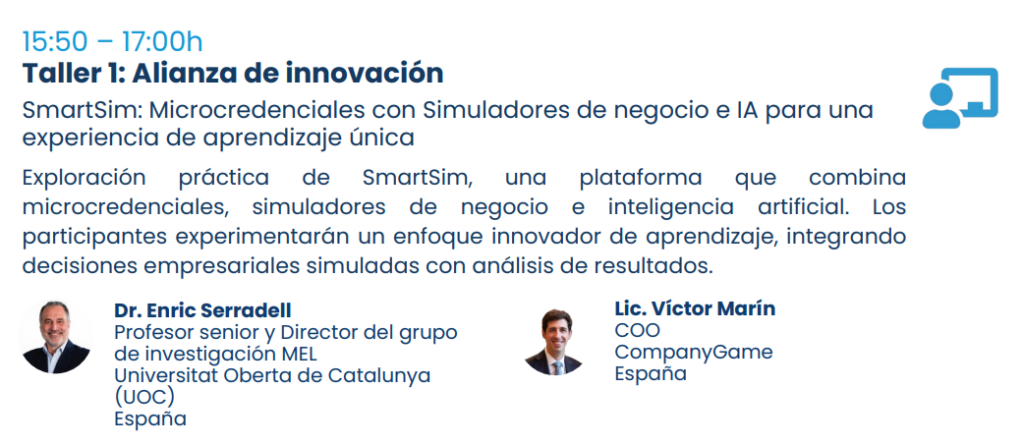
Workshop 1: Innovation Alliance — SmartSim: Microcredentials with Business Simulators and AI for a Unique Learning Experience
15:50 – 17:00
This workshop was one of the most hands-on sessions of the symposium. SmartSim was presented as a platform that combines microcredentials, business simulators and artificial intelligence, offering a direct example of how real evidence can be generated to validate specific competencies.
Speakers:
- Dr. Enric Serradell – Senior Professor and Director of the MEL Research Group, Universitat Oberta de Catalunya (UOC), Spain.
- Víctor Marín – COO, CompanyGame, Spain.
Institutional Panel: Strategies for Integrating Microcredentials into Academic Programmes
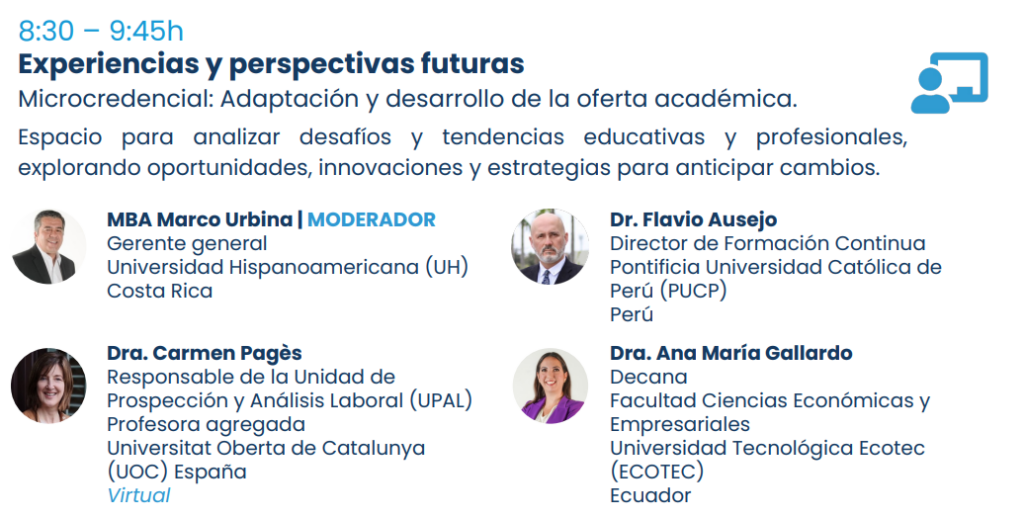
Panel: Microcredential — Adaptation and Development of the Academic Offering: Experiences and Future Perspectives
8:30 – 9:45
This panel brought together academic leaders from several countries to reflect on the challenges and opportunities of integrating microcredentials into university educational offerings.
Participants:
- MBA Marco Urbina – Moderator, General Manager, Universidad Hispanoamericana (UH), Costa Rica.
- Dr. Flavio Ausejo – Director of Continuing Education, Pontificia Universidad Católica del Perú (PUCP), Peru.
- Dr. Carmen Pagès – Head of the Labour Market Analysis and Foresight Unit (UPAL) and Associate Professor at UOC, Spain. (Virtual participation)
- Dr. Ana María Gallardo – Dean, Faculty of Economic and Business Sciences, Universidad Tecnológica Ecotec (ECOTEC), Ecuador.
From Conversations to Theory: Why Microcredentials Are Redefining Competency Validation
The contributions from both the workshop and the panel converged on several theoretical elements that currently guide discussions on microcredentials in higher education.
Impact on the Validation of Specific Competencies
Microcredentials make it possible to certify highly specific skills through verifiable evidence of performance. Unlike traditional methods—often broader and less practice-oriented—these credentials clearly show what a student can do and in what context they demonstrated it.
Microcredentials and Employability: A More Direct Bridge
Employers increasingly seek demonstrable skills, not just degrees. Microcredentials help close this gap by showcasing specific, up-to-date competencies and establishing a common language between academia and industry.
Quality Standards: The Essential Element for Adoption
The symposium emphasised the importance of strong standards:
- precise definition of competencies,
- clear rubrics,
- traceability of evidence,
- interoperability between platforms,
- and transparency in assessment.
Without this framework, a microcredential loses legitimacy; with it, it becomes a highly valuable certification.
Comparison with Traditional Validation Methods
Unlike long programmes, microcredentials offer:
- modularity,
- specificity,
- faster learning,
- and continuous updating.
They are an ideal complement to formal degrees, especially in fast-evolving sectors.
Lifelong Learning
Microcredentials reinforce the philosophy of lifelong learning, enabling professionals to continuously update their profiles and accumulate credentials that reflect their growing skillset.
Conclusion: A Clear Roadmap for the Future of Educational Validation
The 5th Symposium demonstrated that microcredentials not only validate competencies; they also strengthen the connection between education and real professional demands.
The practical SmartSim workshop showed how simulation and AI can generate objective, data-driven assessments, while the institutional panel highlighted that universities are ready to adopt these new models.
The discussions, shared experiences and the Participants Directory published during the symposium open new opportunities for collaboration, research and the development of joint initiatives focused on certifying real-world skills for the labour market.