

Higher education is undergoing one of the most profound transformations in recent history. Labor market demands, rapid technological advances, and the rise of artificial intelligence are driving changes that go far beyond classroom digitalization: we are redefining how we learn, teach, and develop talent.
This discussion was a central focus of the 5th International Symposium on Business Simulation and Educational Innovation, held on November 27–28 in Costa Rica. During the session titled “Educational Transformation and Emerging Trends” (8:45–10:00 a.m.), a space for reflection and dialogue brought together leading academics:
- Dr. Pablo Lara-Navarra (Moderator) – Universitat Oberta de Catalunya (UOC), Spain
- Ing. Gustavo Trigueros – Vice-Rector for Academic Development, Universidad Hispanoamericana (UH), Costa Rica
- Dr. Enrique Alfonso Sánchez – Professor, Universidad Politécnica de Valencia (UPV), Spain
- Dr. Antonia Ferrer – Director, Open Data and Transparency Observatory, UPV, Spain
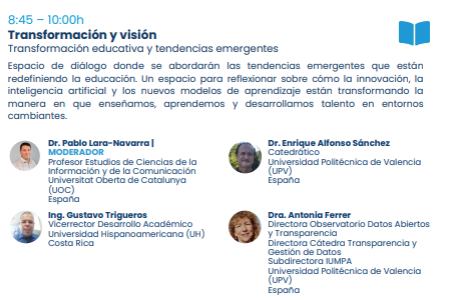
The panel explored the cultural, pedagogical, and technological changes transforming education, with a special focus on their impact on business programs and professional skills development.
1. Active Methodologies: Centering on Meaningful Learning
One key insight was the shift from traditional lecture-based models toward active learning methodologies. These approaches foster critical thinking, collaboration, and problem-solving skills.
Some widely adopted strategies include:
- Challenge-Based Learning (CBL)
- Project-Based Learning (PBL)
- Simulations and gamified environments
- Case studies and decision-making exercises
Such methods allow students to participate actively, make mistakes safely, and develop skills directly applicable to their careers. Business simulators, like those offered by CompanyGame, are an ideal tool to learn by doing, making decisions and seeing their impact in a safe environment.
2. Emerging Technologies: From Tools to Learning Ecosystems
Technology integration is no longer just about devices or digital content; the goal is to create hybrid, measurable, and personalized learning ecosystems.
Highlighted emerging technologies included:
- Artificial Intelligence and learning analytics
- Virtual Reality / Augmented Reality
- Adaptive learning platforms
- Simulated and gamified environments
- Digital credentialing systems (microcredentials)
AI, in particular, enables:
- Personalized learning paths
- Pattern detection and gap identification
- Continuous support for students and teachers
- Automation of repetitive tasks, freeing time for meaningful interaction
However, panelists emphasized that the challenge is not technological but pedagogical and ethical: how to use AI to create a more human, equitable, and accessible education.
3. Hybrid and Flexible Models: Learning Without Boundaries
The pandemic accelerated hybrid models—blending in-person and online—but today their value is strategic.
Flexible programs allow students to:
- Combine theory and practice continuously
- Manage learning pace and schedules
- Access asynchronous resources
- Connect with real-world professional environments
This approach fosters sustainable, contextualized learning that adapts to changing careers and diverse student profiles.
4. Personalized Learning: Students at the Center
Every student learns differently. Digital platforms and intelligent agents enable recognition of these differences and the creation of customized learning paths.
Personalization manifests through:
- Modular curricula
- Competency-based microcredentials
- Adaptive assessments
- Predictive analytics to guide performance
The goal is to balance common learning objectives with flexible paths that respect cognitive, cultural, and emotional diversity.
5. The Evolving Role of Educators: From Content Delivery to Experience Design
If students are at the center, educators are the architects of learning. The symposium emphasized that teachers are not losing relevance—they are transforming it.
Modern educators must:
- Integrate digital tools and hybrid experiences
- Design active learning activities and authentic assessments
- Manage collaborative and emotional dynamics
- Support holistic student development
Teaching is no longer about delivering content; it is about facilitating meaningful experiences.
6. Higher Education: Trends That Are Already the Present
Universities that wish to stand out must adopt a pedagogy focused on competencies, flexibility, and real-world relevance.
Key trends highlighted at the symposium include:
- Competency-based rather than purely theoretical programs
- Hybrid digital ecosystems
- Continuous, practice-oriented assessment
- Market-relevant, verifiable credentials
- Experiential learning through simulations
- Lifelong learning approaches
Institutions embracing these trends can attract talent, strengthen their brand, and improve graduates’ employability.
Conclusion: Transformation Is Not About Technology, It’s About Reinventing Education
Educational transformation is not about replacing chalkboards with digital platforms; it’s about rethinking the purpose of teaching. The challenge is to design learning experiences that connect with the business world, develop critical skills, and place students at the center.
At CompanyGame, we firmly believe that business simulators, gamification, and immersive experiences are essential tools in this process. They allow students to experiment safely, make decisions, learn from mistakes, and gain real-world skills.
The 5th International Symposium was a platform to reflect, share, and envision a new educational paradigm—a journey that is only beginning, inviting continued innovation and impactful learning.