
The rise of artificial intelligence (AI) in education is significantly transforming how we teach and learn. During the 5th International Symposium on Business Simulation and Educational Innovation, held on November 27–28 in Costa Rica, several sessions focused on strategies, practical cases, and future perspectives of AI in educational environments, highlighting both its opportunities and challenges.
1. Future Perspectives: AI as a Driver of Learning
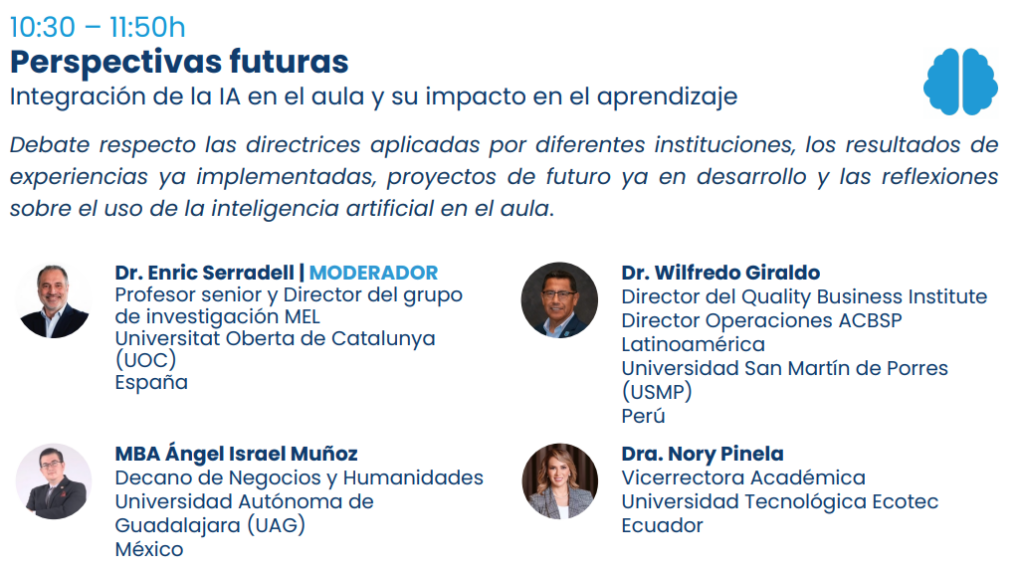
The first session on this topic, “Integration of AI in the Classroom and Its Impact on Learning” (10:30–11:50 a.m.), brought together experts from various institutions to discuss guidelines, implemented experiences, and ongoing projects:
- Dr. Enric Serradell – Universitat Oberta de Catalunya (UOC), Spain (Moderator)
- Dr. Wilfredo Giraldo – Universidad San Martín de Porres (USMP), Peru
- MBA Ángel Israel Muñoz – Universidad Autónoma de Guadalajara (UAG), Mexico
- Dr. Nory Pinela – Universidad Tecnológica Ecotec, Ecuador
Panelists discussed how AI can support teachers, assist students in both virtual and in-person environments, facilitate automated assessments, and provide personalized feedback, while also transforming educational roles and enhancing student competencies.
2. Success Stories: AI Applied in Education
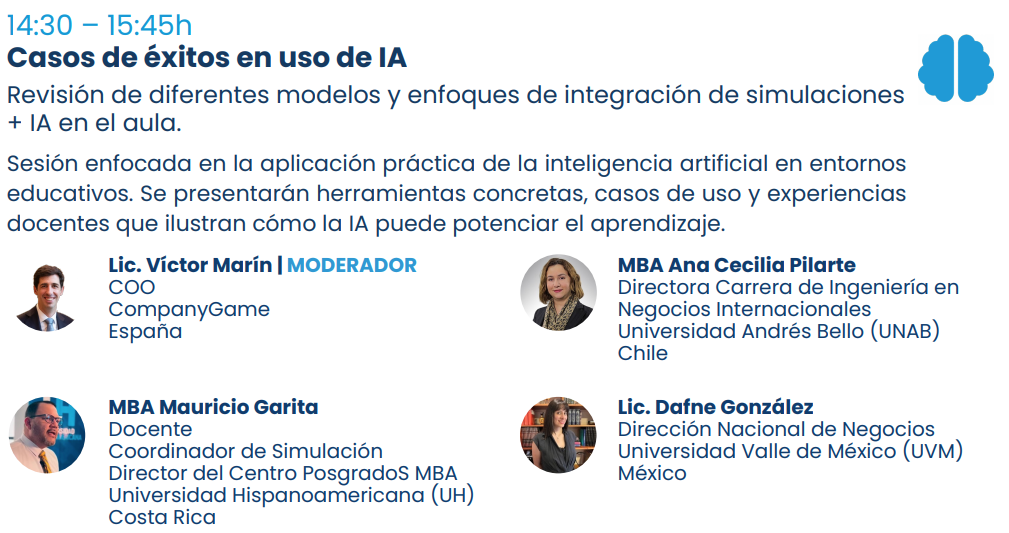
In the second session, “Success Cases in the Use of AI” (14:30–15:45), participants shared practical examples of integrating simulators and AI tools in the classroom, showcasing measurable results and lessons learned:
- Lic. Víctor Marín – COO, CompanyGame, Spain (Moderator)
- MBA Ana Cecilia Pilarte – Universidad Andrés Bello (UNAB), Chile
- MBA Mauricio Garita – Universidad Hispanoamericana (UH), Costa Rica
- Lic. Dafne González – Universidad Valle de México (UVM), Mexico
The session highlighted tools and methodologies that enhance learning, increase student engagement, and optimize teacher effectiveness, demonstrating that AI can enrich education without replacing the human element.
3. Student Development: Power Skills and Simulation
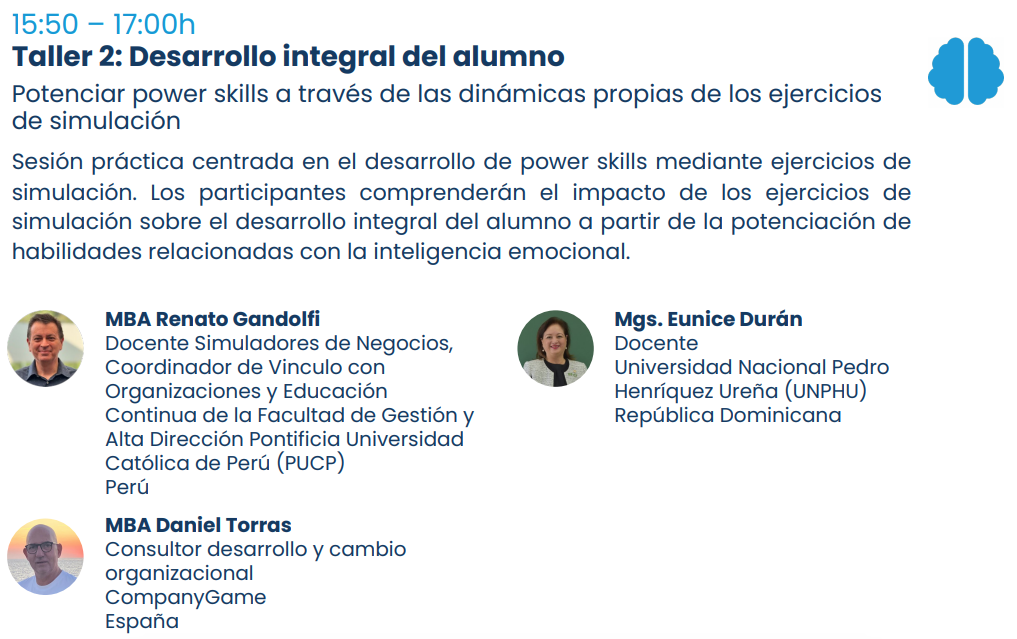
The third session (16:50–17:00), “Workshop 2: Integral Student Development”, focused on how simulation exercises, enhanced by AI, contribute to developing transversal skills (power skills) such as:
- Emotional intelligence
- Teamwork
- Decision-making
- Critical thinking
Participants included educators and experts from multiple universities:
- MBA Renato Gandolfi – PUCP, Peru
- Mgs. Eunice Durán – UNPHU, Dominican Republic
- MBA Daniel Torras – CompanyGame, Spain
Workshops showed that simulation-based learning supported by AI strengthens both cognitive and emotional skills, preparing students for complex professional environments.
4. Opportunities in the AI Era: Innovation and Personalization
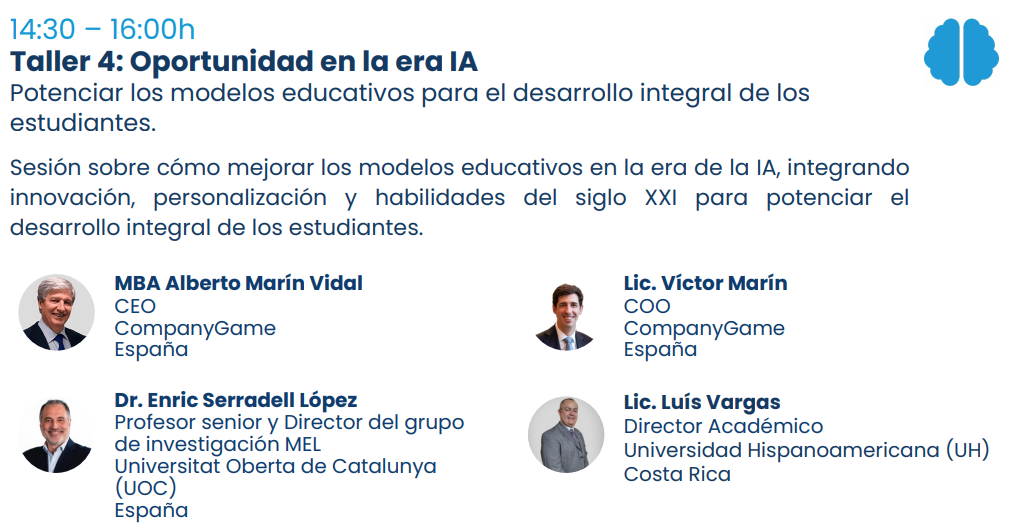
The fourth highlighted session (14:30–16:00), “Workshop 4: Opportunities in the AI Era”, explored how AI integration can enhance educational models, allowing for personalized learning, methodological innovation, and holistic student development. Speakers included:
- MBA Alberto Marín Vidal – CEO, CompanyGame, Spain
- Lic. Víctor Marín – COO, CompanyGame, Spain
- Dr. Enric Serradell López – UOC, Spain
- Lic. Luís Vargas – Universidad Hispanoamericana (UH), Costa Rica
It was emphasized that AI does not replace teachers but multiplies their ability to guide, facilitates personalized assessment, and enables more adaptive and meaningful learning experiences.
5. Ethical Challenges and Future Outlook
Beyond opportunities, the panels addressed the ethical aspects of AI in education, such as:
- Data privacy and student information protection
- Algorithmic transparency and bias
- Responsible integration without compromising the human dimension of learning
Experts agreed that the future of education requires balancing technological innovation with ethical principles, ensuring AI enhances learning and holistic development without replacing human interaction.
Conclusion
Integrating AI in the classroom is no longer a distant future—it is already transforming how we teach and learn. The 5th International Symposium demonstrated that, when combined with simulators, gamification, and solid pedagogical strategies, AI can:
- Personalize learning
- Support both teachers and students
- Strengthen cognitive and emotional competencies
- Provide more meaningful and effective learning experiences
At CompanyGame, we firmly believe that AI, when applied thoughtfully, is a strategic ally in 21st-century education, preparing students for an increasingly complex, digital, and global professional world.