
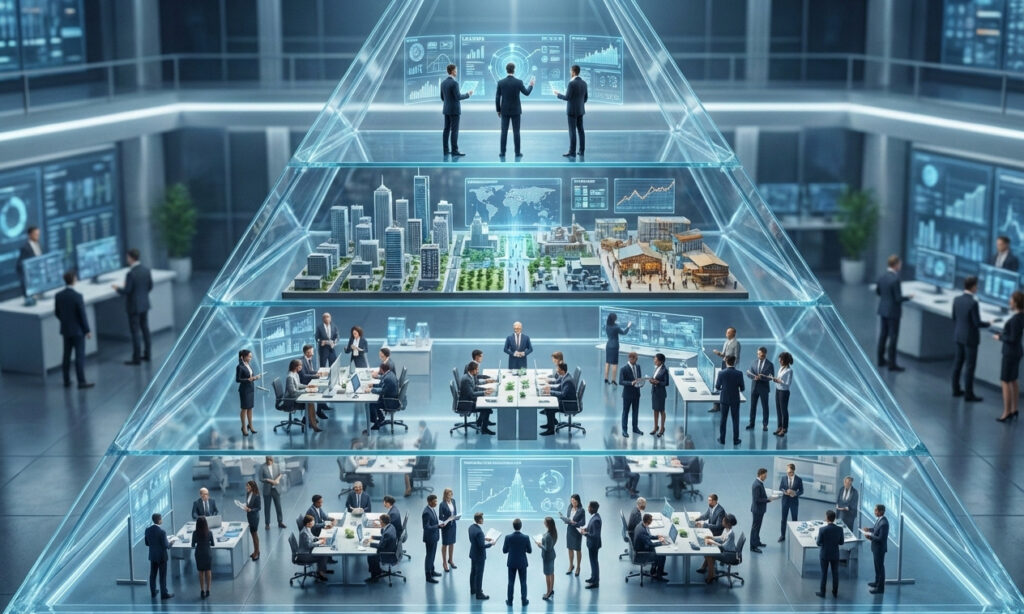
In an environment marked by uncertainty, complexity, and constant change, leadership development can no longer rely solely on technical knowledge transfer. The real challenge lies in cultivating deep competencies that enable individuals to understand themselves, relate effectively to others, and act with sound judgment in real-world contexts. Within this framework, the leadership pyramid emerges as a clear and powerful model for structuring leadership development—especially when activated through business simulation.
The Leadership Pyramid as a Competency Development Framework
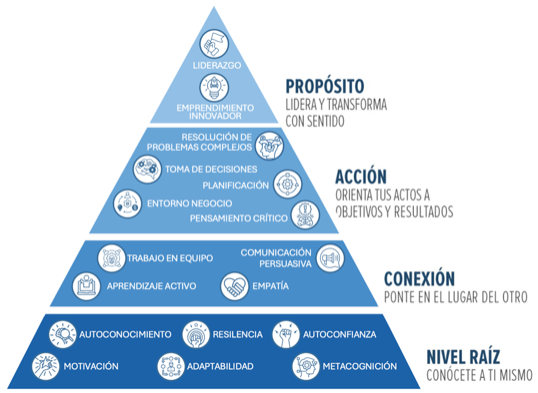
The leadership pyramid represents the progressive process through which participants build their leadership capacity. It is not a collection of isolated skills, but an interdependent system in which each level supports the next.
At the base of the pyramid are personal competencies, which are essential for any professional development journey. These include self-awareness, self-confidence, metacognition, and resilience. Together, they enable participants to understand how they think, how they respond under pressure, and how they learn from experience. Without this foundation, leadership efforts become fragile and unsustainable.
The intermediate level consists of relational competencies such as empathy, communication, active learning, and teamwork. Here, the focus shifts from the self to interaction with others. Participants learn to listen, interpret group dynamics, manage conflict, and build trust. This is where leadership begins to take shape through relationships.
At the top of the pyramid are competencies of action and purpose: decision-making, critical thinking, leadership, and innovative entrepreneurship. This level reflects the ability to act with judgment, assume responsibility, and generate impact. However, reaching this level sustainably is only possible when the underlying layers are firmly developed.
Business Simulation: Activating the Pyramid Systemically
When designed from a transformational learning perspective, business simulation activates all levels of the leadership pyramid in an integrated way. A participant cannot lead effectively without prior self-awareness and emotional regulation, nor can they make complex decisions without understanding how they interact with others and how their actions affect the broader system.
Unlike traditional training approaches, simulation does not fragment competencies. Instead, it places participants in realistic scenarios where they must decide, interact, face consequences, and reflect on outcomes. Each decision connects personal awareness, relational dynamics, and strategic action—mirroring the complexity of real leadership.
In this sense, business simulation trains not only what to do, but who you are while doing it, a critical dimension in the development of authentic and adaptive leaders.
Power Skills: From Abstract Concepts to Lived Experience
So-called power skills—such as leadership, communication, emotional management, and critical thinking—cannot be developed through direct instruction alone. Explaining them or assessing them theoretically is not enough. They require experience, reflection, and confrontation with reality.
Business simulation provides a safe yet demanding space where these competencies are truly tested. When participants learn to listen to their team after a conflict, manage the frustration of a poor decision, or lead without imposing authority, they undergo experiences that foster deep learning.
This process goes beyond behavioral change. It generates an identity shift: participants begin to see themselves as professionals capable of learning from experience, adapting to complex environments, and leading with purpose. This transformation is the foundation of sustainable leadership.
Leadership Is Not a Role, but a Development Process
The leadership pyramid reminds us that leadership is neither improvised nor imposed. It is built from the inside out, integrating personal, relational, and strategic competencies. Business simulation—when designed with strong pedagogical intent—becomes one of the most powerful tools to activate this process.
At CompanyGame, we design simulations that go beyond teaching how to manage organizations. Our goal is to develop leaders who can make conscious decisions, collaborate effectively, and act with purpose in real-world environments. Because leadership is not just about reaching the top of the pyramid, but about sustaining it with a solid and coherent foundation.
By: Daniel Torras and Alberto Marín.