
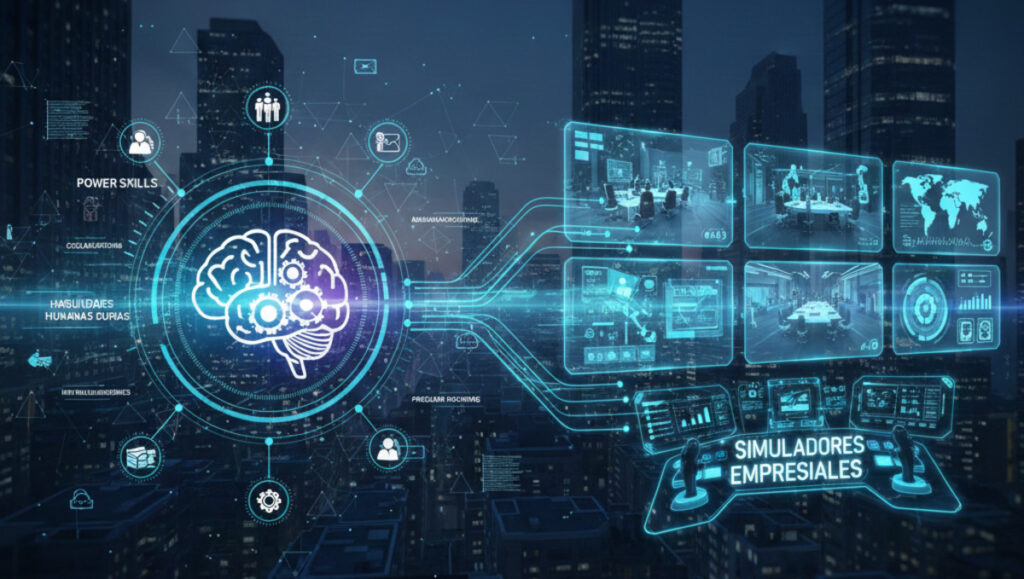
For years, business education has prioritized technical knowledge. However, professional practice shows that knowing is not enough. What truly matters is the ability to act with judgment in complex contexts, interact with others, manage emotions, and lead with awareness. In this context, power skills—or high-impact human skills—find in business simulators an especially effective environment for their development.
From “Soft Skills” to Power Skills
The term soft skills has historically contributed to undervaluing essential competencies. Research in neuroscience and education, from Daniel Goleman to David Kolb, has shown that the skills most critical for professional performance are not technical but human. The labor market reinforces this idea, demanding profiles capable of communicating, collaborating, adapting, and leading with purpose.
Therefore, it is more accurate to speak of high-impact human skills: abilities that no machine can replicate and that transform knowledge into meaningful action. They do not replace technical skills—they enhance them. They are the bridge between knowing and knowing how to act with purpose.
What They Are and Why They Matter
Power skills integrate emotional management, critical thinking, and the ability to navigate complexity. They do not merely enable achieving objectives but allow individuals to positively influence others, learn from mistakes, and act responsibly. As the OECD points out, the current educational challenge is to develop people capable of creating value and assuming social responsibility in changing environments.
These skills are not taught through direct instruction. They are developed through experience, reflection, and confrontation with reality. This is where business simulation makes a difference.
Business Simulation: Where Skills Emerge
In simulation environments, human skills are not explained—they emerge. They arise in interaction, shared decision-making, conflict, and negotiation under pressure. Empathy, active listening, and emotional self-management cease to be abstract concepts and become observable behaviors.
When a participant learns to manage conflict, take responsibility for a poor decision, or lead without imposing, a profound change occurs. It is not only behavioral but also identity-related: the individual begins to see themselves as a professional capable of learning, adapting, and leading in complex contexts.
Deep Learning and Experience
David Kolb noted that knowledge is created through the transformation of experience. Business simulation activates this process by integrating action, reflection, and experimentation. However, evidence shows that mere teamwork does not guarantee the development of human skills without a clear pedagogical intention.
As Daniel Goleman warns, when emotional competencies are not cultivated explicitly, teams often display unresolved conflicts and underperformance. Therefore, the development of power skills must be planned progressively and guided, especially in the early stages of training.
From Guidance to Autonomy
Educational literature agrees that these skills develop in contexts that demand action and progressively increasing autonomy. In business simulators, this process typically progresses from a guided stage focused on self-confidence, to a facilitated stage of collaboration, and finally to an autonomous stage where critical thinking and leadership emerge.
At this point, the role of the instructor changes: they stop directing and begin to provoke reflection, challenge assumptions, and support learning. This is where power skills manifest most clearly.
A New Educational Paradigm
In a world increasingly mediated by artificial intelligence, value no longer resides in information but in interpretation and human connection. The leadership of the future will belong to those who integrate reason and emotion, results and relationships, diversity and purpose.
At CompanyGame, we understand business simulators as spaces for human development, where technical knowledge is transformed into conscious action and purposeful leadership.
By: Daniel Torras and Alberto Marín.