
For years, universities have focused a large part of their assessment on the acquisition of knowledge. However, in an increasingly dynamic professional environment, what truly makes the difference is not only what students know, but what they are able to do with that knowledge.
In this context, competency-based assessment becomes a key element. And among the available methodologies, the assessment center stands out as one of the most comprehensive and effective.
1. What is an assessment center and why is it relevant in education?
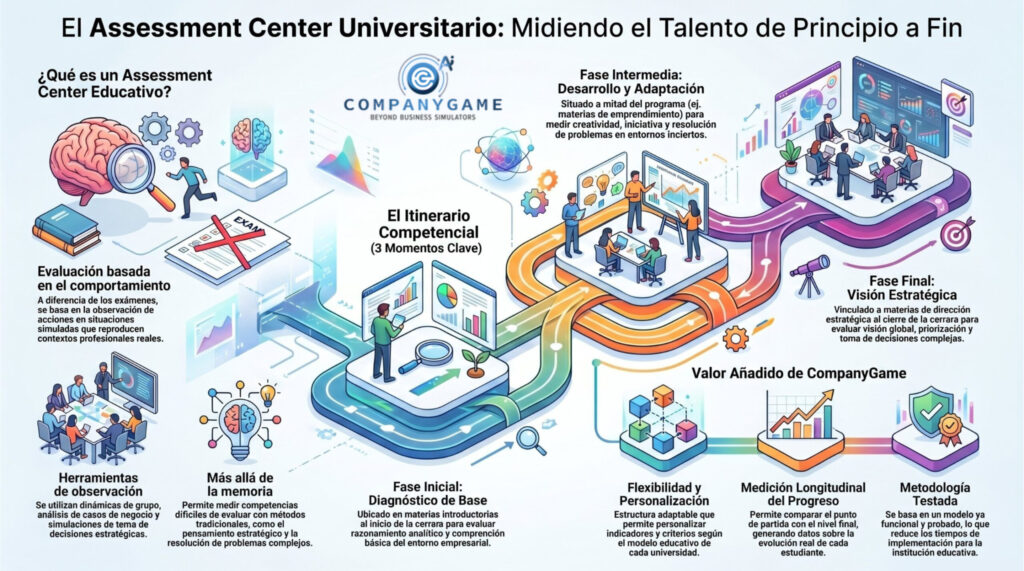
An assessment center is an evaluation methodology based on the observation of behaviors in simulated situations that replicate real-world contexts. Through structured activities such as case analysis, simulations, group dynamics, or strategic decision-making, it is possible to assess competencies in an objective and contextualized way.
Traditionally, this methodology has been used in corporate environments, especially in selection, promotion, or talent development processes. However, its application in the university context is particularly valuable, as it allows the measurement of competencies that are difficult to assess through traditional exams.
Competencies such as strategic thinking, communication, leadership, decision-making, or problem-solving require observing how students act in complex situations, not just evaluating their ability to memorize content.
The need to assess competencies over time
One of the major challenges in university degree programs, especially in areas such as Business Administration, is ensuring that students develop a clear set of competencies throughout their education.
The problem is usually not the definition of competencies, but the lack of a structured system that allows them to be assessed progressively and coherently.
Competencies do not develop immediately or uniformly. Some appear in early stages, while others require academic maturity and accumulated experience. For this reason, assessing them at a single final moment is insufficient.
A more effective approach consists of establishing evaluation moments distributed throughout the degree, allowing institutions to measure the starting point, observe progress, and assess the level achieved at the end of the program.
Three key moments for effective competency-based assessment
A particularly coherent structure consists of integrating assessment at three strategic moments within the learning pathway.
The first moment can be placed at the beginning of the degree, in an introductory course related to the business field. At this stage, the objective is to assess basic competencies such as analytical reasoning, understanding of the business environment, or the ability to interpret information.
The second moment can be located halfway through the program, in subjects related to entrepreneurship. Here, competencies such as creativity, initiative, adaptability, and problem-solving in uncertain environments come into play.
Finally, a third moment at the end of the degree, linked to strategic management courses, allows the assessment of more complex competencies such as global vision, strategic thinking, prioritization, or decision-making in complex scenarios.
This approach not only enables assessment, but also supports the progressive and meaningful development of student competencies.
2. The CompanyGame proposal: assessment centers adapted to the university reality
At CompanyGame, we have spent years working with business simulations and active methodologies that allow behaviors to be observed and decisions to be made in realistic environments. This experience has enabled us to develop a core assessment center structure specifically designed for the university context.
Our goal is not to offer a rigid model, but a flexible solution that can be adapted to the needs of each institution.
A flexible and adaptable core structure
We have designed an assessment center structure that can be integrated into three key subjects within the degree:
An initial assessment in the early years, linked to the introduction to the business world.
An intermediate assessment in subjects related to entrepreneurship.
A final assessment focused on strategic management.
This structure allows universities to measure competencies at different stages of the academic pathway, maintaining methodological consistency and comparability across results.
At the same time, we understand that competencies may vary between universities depending on their educational model or training priorities. For this reason, our proposal is based on a shared methodological foundation, while allowing institutions to customize indicators and evaluation criteria according to their specific needs.
Measuring real student progress
One of the most valuable aspects of this approach is the possibility of measuring competency development throughout the entire degree.
It is not only about assessing at the end, but about comparing the starting point with the progress achieved in later stages. This enables universities to obtain a longitudinal view of student development and generate useful information for continuous learning improvement.
Furthermore, this information can become a differentiating factor for both students and institutions, by providing clear evidence of the development of professional competencies.
A tested and functional foundation
Our proposal does not start from scratch. It is based on a methodological structure already tested in different training contexts, ensuring its functionality and facilitating its implementation.
The objective is for universities to adopt a solid model without the need to design it entirely from the beginning, reducing development time and ensuring consistency in evaluation processes.
Toward more meaningful university assessment
Competency-based assessment represents one of the major current challenges in higher education. But it also represents an opportunity to transform the way we measure learning and support student development.
At CompanyGame, we believe that the assessment center can become a key tool to achieve this: a methodology that not only measures results, but makes visible the growth, evolution, and real capacity of students to act in business contexts.
And that is precisely the direction we aim to move toward: offering universities a structured, adaptable model focused on measuring competencies throughout the entire degree. Because training professionals is not only about transmitting knowledge, but about demonstrating that competencies have truly been developed.