
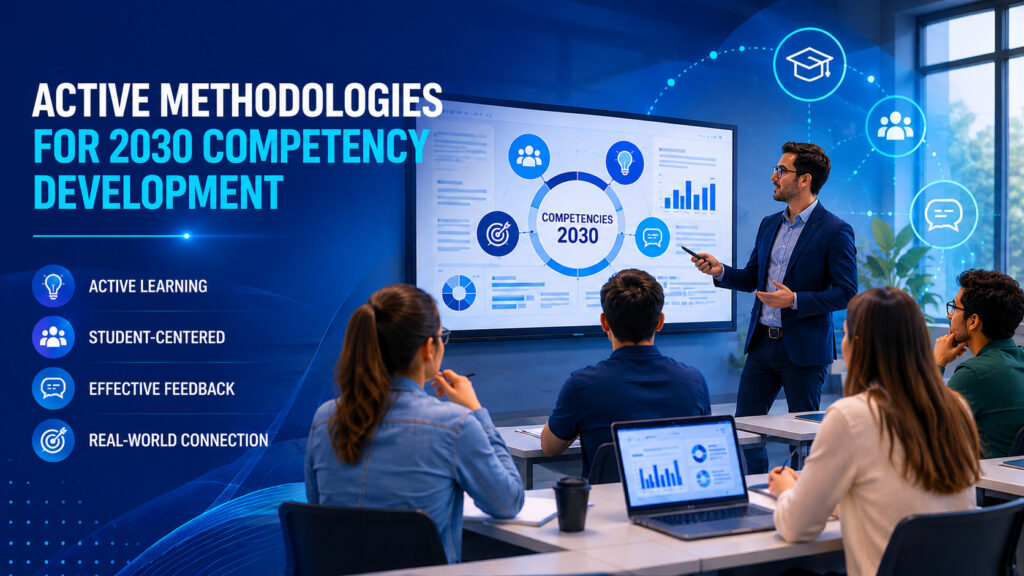
The transformation of the labor market is driving profound changes in higher education. Organizations are demanding professionals capable of solving complex problems, working in teams, adapting to changing environments, and making decisions under uncertainty. In this context, universities face the challenge of training graduates who not only possess technical knowledge but also the competencies required to succeed in the professional world.
In this line, the article “Active Methodologies for the Development of 2030 Competencies”, developed by Arely Anabel Martínez Presas, Andrea Noemí Vázquez Acuña, and Laura Patricia Garza Rodríguez from CNCI University (Mexico), offers an important reflection on the need to evolve educational models to respond to current labor market demands.
The Gap Between University and Industry
One of the most interesting aspects of the study is that it emerges from a need identified by both graduates and employers. The authors highlight the importance of analyzing the competencies currently demanded by companies and contrasting them with the skills developed during university education.
This approach is particularly valuable because it places both the student and the labor market at the center of the analysis. In a context where technological and organizational change is accelerating, reducing the gap between academic training and professional reality becomes a strategic priority for any educational institution.
Active Methodologies as a Response
Active learning methodologies have proven to be one of the most effective tools for developing both technical and transversal competencies. Unlike traditional approaches focused on content transmission, these methodologies turn students into the protagonists of their own learning process.
Project-based learning, problem-based learning, case studies, business simulations, collaborative challenges, and immersive experiences are some examples of strategies that allow students to learn through practice, reflection, and decision-making.
Particularly relevant are experiential learning approaches and business simulations, which reproduce situations similar to those students will encounter in their future professional careers. These experiences foster the development of competencies such as critical thinking, analytical ability, communication, leadership, and problem-solving in safe environments where mistakes become learning opportunities.
The Teacher as a Learning Facilitator
However, the article highlights an aspect that often receives less attention: the role of the teacher.
The authors state that:
“It is necessary to consider training and professional development processes for teachers, so that they can empower their teaching practice, not only by developing strategies to assess technical knowledge and soft skills, but also to provide adequate support to students in solving doubts, guiding their progress, evaluating and giving feedback on their learning—key elements in developing the competencies essential for academic and professional performance.”
This reflection is particularly relevant because the effective implementation of active methodologies does not depend solely on innovative tools or technological resources. It requires teachers to assume a new role.
In active learning models, the teacher is no longer exclusively a transmitter of information but becomes a guide, mentor, and facilitator of the learning process. Their role is to accompany students, design appropriate challenges, foster critical reflection, and provide feedback that drives continuous improvement.
The Importance of Feedback and Debriefing
Among the competencies teachers need to develop, those related to facilitation and feedback are especially important.
In methodologies such as simulations, case studies, or project-based learning, much of the educational value emerges after the experience. It is during the reflective phase that students connect their decisions with the outcomes and extract transferable lessons for future contexts.
Therefore, skills such as constructive feedback, educational coaching, reflective questioning, and the facilitation of debriefing sessions become essential to maximize the impact of active learning.
Technology can enable innovative learning experiences, but it is the teacher’s pedagogical intervention that transforms those experiences into genuine opportunities for competency development.
An Institutional Challenge
Teacher training should not be understood solely as an individual responsibility. It is also a strategic challenge for educational institutions.
If universities aim to promote competency-based learning models, they must support teachers through training programs, spaces for pedagogical experimentation, and resources that facilitate the effective adoption of active methodologies.
Educational transformation requires investment not only in technology and tools but also in the professional development of those who lead learning processes.
Final Reflection
The competencies required by the labor market continue to evolve, and higher education must evolve with them. Active methodologies represent an effective way to bring universities closer to professional reality, foster meaningful learning, and better prepare students for future challenges.
However, their success depends largely on teachers’ ability to assume new roles and develop new pedagogical competencies. Training in facilitation, feedback, and learning support is no longer optional; it is a key element in ensuring education is aligned with the needs of the 21st century.
Questions for Reflection
- Am I aware of the need to incorporate active learning methodologies into my instructional design?
- Have I accepted that my role as a teacher must evolve toward that of a guide and facilitator?
- Do I have the knowledge and experience to conduct effective feedback and debriefing processes?
- Do I have the resources, time, and institutional support needed to continue my professional development?
- What actions can I take to strengthen my competencies as a learning facilitator?
- Is this approach a strategic priority in my institution? How can I contribute to promoting it?