
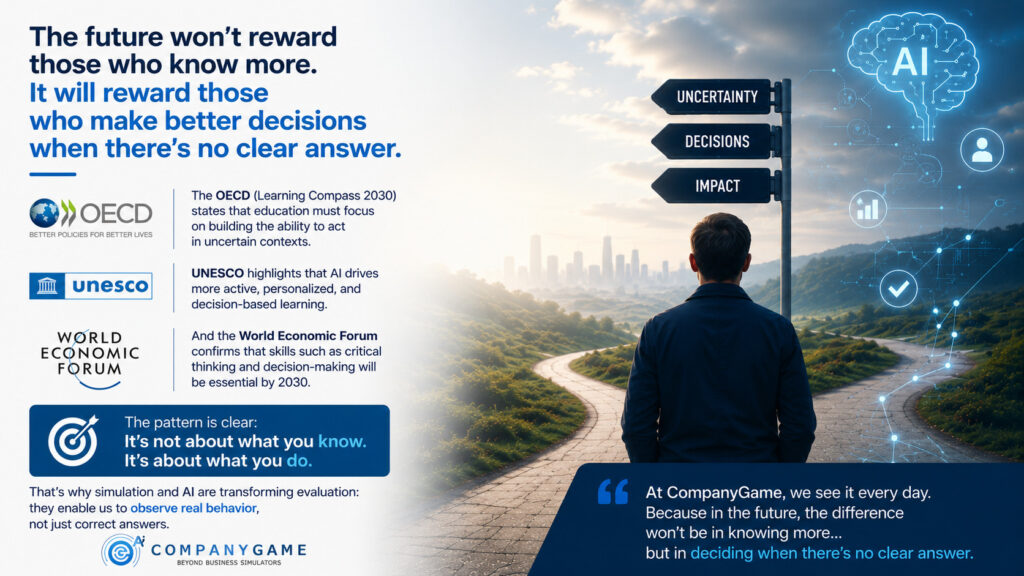
For years, much of education focused on transmitting information. The goal was to learn content, memorize concepts, and accumulate knowledge.
But the world has changed.
Today, the problem is no longer access to information. Information is everywhere, available within seconds and in virtually unlimited quantities.
The real challenge is different: knowing how to interpret, analyze, and make decisions in increasingly complex environments.
That is why the future of education is not simply about knowing more.
It is about making better decisions.
From Knowledge to Action
Organizations are no longer looking only for people who “know.” They are looking for people who can act.
Professionals who can:
- solve problems,
- prioritize under pressure,
- analyze scenarios,
- manage uncertainty,
- and make impactful decisions.
This completely changes the logic of learning.
The focus is no longer only on acquiring information, but on developing applied capabilities.
Decision-Making as a Key Competency
Decision-making is a transversal skill that affects almost every professional role.
Every day, people must:
- choose strategies,
- manage conflicts,
- react to change,
- interpret data,
- coordinate teams,
- or respond to unexpected situations.
However, education still often evaluates memory more than judgment.
And this is where one of the biggest gaps between education and professional reality appears.
Learning by Doing
Traditional methodologies struggle to train complex skills through theory alone.
That is why more experiential models are growing, where learning happens through practice, simulation, and interaction.
When a person:
- makes decisions,
- faces consequences,
- receives feedback,
- and adjusts their strategy,
learning becomes much deeper and more transferable to the real world.
Simulation and Applied Learning
Educational simulators make it possible to recreate situations close to professional reality in safe environments where participants can experiment, make mistakes, and learn.
This allows the development of competencies such as:
- strategic thinking,
- leadership,
- business management,
- problem-solving,
- and decision-making under pressure.
Beyond consuming content, learners actively participate in the process.
And that completely transforms the learning experience.
The New Role of Technology
Artificial intelligence and digital platforms are accelerating this transformation.
Technology is no longer used only to distribute content, but also to:
- personalize experiences,
- adapt scenarios,
- generate immediate feedback,
- measure performance,
- and assess competencies in real time.
This makes learning more dynamic, practical, and aligned with real professional needs.
The CompanyGame Approach
At CompanyGame, we have spent years developing learning models based on simulation and decision-making.
We believe that the most important competencies are not developed only by reading theory, but by facing scenarios where decisions have consequences.
That is why we design experiences where participants can train strategic, business, and leadership skills in interactive environments close to reality.
The Future of Learning
The future of education will not simply be more digital.
It will be more active, more experiential, and more focused on real competencies.
Because in a world where information is accessible to everyone, the difference will no longer be determined by who knows more.
It will be determined by who makes better decisions.