
The emergence of artificial intelligence is profoundly transforming the way we access information, learn, and work. In this context, some voices are asking whether universities will continue to play the same role they have historically held, or whether part of their function will be replaced by intelligent systems capable of delivering personalized knowledge at scale.
However, this view is based on an incomplete premise. The university has never been solely a space for the transmission of knowledge. Its true contribution to society lies in something much deeper: accompanying people in a process of comprehensive transformation that enables them to become competent professionals, critical citizens, and leaders capable of making decisions in complex and uncertain contexts.
This vision connects directly with the concept of Integral Student Development. The university’s mission is not only to transmit technical knowledge but to foster balanced growth in both disciplinary capabilities and the human skills needed to function in today’s society. The true value of higher education arises precisely from the integration of both dimensions, enabling students to develop judgment, responsibility, collaboration, and professional autonomy.
It is precisely for this reason that, in a world increasingly influenced by artificial intelligence, the role of the university is not diminishing. On the contrary, it is becoming even more relevant.
Decision-making is already a priority in universities’ mission
The importance of decision-making is not a trend driven by new technologies nor an isolated proposal from educational innovation experts. It is enough to review institutional statements, educational models, and learning outcomes from numerous universities to see that competencies such as critical thinking, problem-solving, professional judgment, analytical ability, and decision-making are part of their strategic objectives.
Universities themselves recognize that training professionals involves much more than transmitting disciplinary knowledge. It means preparing students to face ambiguous situations, evaluate alternatives, manage incomplete information, and assume the consequences of their decisions.
In other words, the university does not only teach what to think; it teaches how to think and how to act.
This dimension takes on special importance in a context where artificial intelligence can generate answers instantly. The true differentiating value of future professionals will not lie solely in accessing information, but in interpreting it, questioning it, contextualizing it, and transforming it into responsible decisions.
This vision is not limited to the institutional strategies of universities. International organizations such as UNESCO and the OECD have for years advocated that education must prepare people to navigate complex, uncertain, and changing environments. The OECD’s Learning Compass 2030 framework places the ability to act responsibly, resolve dilemmas, and assume the consequences of one’s own decisions as central elements of 21st-century education. Similarly, UNESCO, through initiatives such as Futures of Education and Reimagining Our Futures Together, emphasizes the need to train people capable of exercising critical judgment, actively participating in society, and building desirable futures.
The importance of this competency is also reflected in the labor market. The World Economic Forum’s Future of Jobs 2025 report identifies analytical thinking, complex problem-solving, adaptability, leadership, and influence as some of the most in-demand skills by organizations. It is significant that many of these are directly related to the ability to make decisions in uncertain and changing contexts.
The university experience is much more than acquiring knowledge
Reducing the university to a repository of content would be to ignore the complexity of the formative experience lived by millions of students every year.
During their time at university, students participate in collaborative projects, debate ideas, work in teams, face real challenges, develop communication skills, manage conflicts, build professional networks, and learn to navigate increasingly diverse environments.
All of this forms part of a process of personal and professional development that goes far beyond conceptual learning.
From this perspective, Integral Development should not be understood as a complement to academic training, but as its natural outcome. Technical knowledge remains a fundamental requirement, but it reaches its maximum value when combined with skills such as communication, teamwork, leadership, adaptability, emotional intelligence, and the ability to make responsible decisions.
The university constitutes a unique environment where students experiment, make mistakes, reflect, and evolve. It is precisely this combination of knowledge, experiences, human interaction, and academic guidance that makes higher education a transformative experience.
No technological tool can reproduce this process on its own.
Artificial intelligence can provide information, suggestions, or personalized support. It can accelerate certain tasks and even enrich learning. But it cannot replace the progressive construction of a student’s professional identity nor the set of human experiences that shape their integral development.
This idea is supported by David Kolb’s theory of experiential learning. According to this approach, people learn more deeply when they combine knowledge, action, reflection, and experimentation. Effective learning does not occur solely through the reception of information, but through experience and the ability to analyze the consequences of one’s own actions. The university provides precisely this environment where students can experiment, reflect, and develop judgment before facing the challenges of the professional world.
Therefore, both in-person and online universities will continue to play an essential role in society. Formats may evolve, methodologies may change, and technologies will continue to advance, but the university’s transformative mission will remain intact.
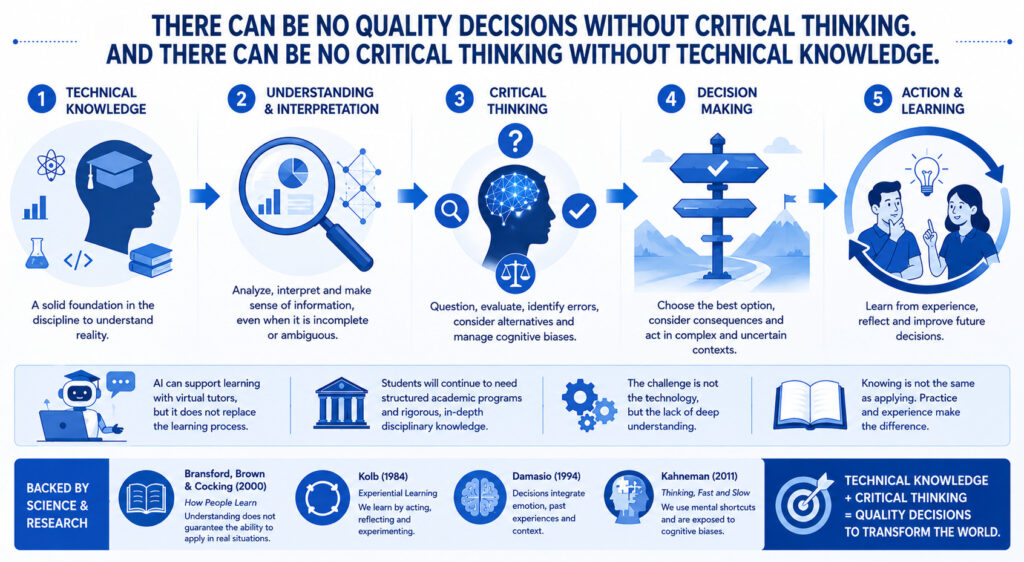
There is no critical thinking without technical knowledge
In recent months, debates have proliferated about whether artificial intelligence will reduce the need to learn certain content or specialized knowledge. However, this view ignores a fundamental reality: to think critically, one must have a solid foundation of technical knowledge.
As Xavier Ferràs noted in a recent reflection published in La Vanguardia, it is perfectly possible to imagine a future in which students are accompanied by virtual tutors based on artificial intelligence. But those students will still be part of structured academic programs and will continue to need to develop rigorous knowledge in their respective disciplines.
The reason is simple. The ability to evaluate alternatives, detect errors, question recommendations, or make well-founded decisions depends directly on the person’s level of understanding.
Educational research has consistently shown that understanding a concept does not necessarily guarantee the ability to apply it effectively in real contexts. As Bransford, Brown, and Cocking explain in How People Learn, there is an important difference between acquiring knowledge and being able to use it when new, ambiguous, or uncertain situations arise.
Educational experience constantly demonstrates this. When students participate in simulators, applied projects, or complex decision-making situations, the most common difficulties are usually not related to the available technology, but to the lack of understanding of certain concepts, models, or discipline-specific tools.
Without technical knowledge, it is difficult to interpret a situation. Without interpretation, it is impossible to make a judgment. And without judgment, there can be no quality decision-making.
Modern neuroscience also supports this idea. Antonio Damasio’s research demonstrated that human decisions do not depend solely on logical reasoning, but also on the ability to interpret previous experiences, emotions, and contextual cues. Later, Daniel Kahneman showed how people use mental shortcuts and are exposed to cognitive biases that constantly influence their decisions. Managing these biases appropriately requires knowledge, reflection, and deliberate practice.
Therefore, far from losing importance, disciplinary knowledge remains the foundation upon which critical thinking and decision-making capacity are built.
However, the goal of higher education is not only to strengthen that technical knowledge. The real challenge is to integrate it with so-called Power Skills or transversal competencies. The ability to analyze complex situations, collaborate with others, lead teams, manage uncertainty, or communicate decisions requires both disciplinary knowledge and human competencies. It is precisely this combination that drives Integral Student Development and shapes a professional profile prepared to face the challenges of an ever-changing environment.
There can be no decision-making without critical thinking. And there can be no critical thinking without technical knowledge.
“The more artificial intelligence-based technologies advance, the more important specifically human capabilities become”
The emergence of artificial intelligence represents an extraordinary opportunity to enrich higher education. Intelligent systems can offer personalized tutoring, facilitate access to resources, provide immediate feedback, and adapt to different learning paces.
However, their greatest potential does not lie in replacing the university, but in complementing its work.
Paradoxically, the more artificial intelligence-based technologies advance, the more important specifically human capabilities related to judgment, interpretation, professional discernment, and decision-making become. The UNESCO AI Competency Framework for Students published in 2024 emphasizes precisely that learning must evolve from simple understanding toward the ability to apply, evaluate, and create using available knowledge.
The fundamental mission of higher education institutions will continue to be to accompany students throughout their personal and professional transformation process. Technology can strengthen this accompaniment, but it cannot replace it.
The training of professionals capable of analyzing, deciding, collaborating, leading, and acting with judgment will continue to require structured educational environments, meaningful experiences, and academic communities committed to the integral development of people.
In this context, Integral Development is consolidated as one of the great objectives of higher education. University education can no longer focus exclusively on the acquisition of technical knowledge, even though it remains essential. The true differentiator for future professionals will lie in their ability to combine that knowledge with judgment, critical thinking, leadership, ethics, collaboration, and responsible decision-making.
In a future where artificial intelligence will be present in practically all areas of life, the question will not be whether the university remains necessary.
The real question will be how universities can leverage artificial intelligence to further enhance what has always made them indispensable: forming people capable of understanding the world, transforming it, and making responsible decisions to build the future.
Bibliography
- Bransford, J. D., Brown, A. L., & Cocking, R. R. (2000). How People Learn: Brain, Mind, Experience, and School. Expanded Edition. Link: https://nap.nationalacademies.org/catalog/9853/how-people-learn-brain-mind-experience-and-school-expanded-edition
- Chernikova, O., et al. (2020). Simulation-Based Learning in Higher Education: A Meta-Analysis. Link: https://journals.sagepub.com/doi/10.3102/0034654320933544 (Sage Journals) Alternative: https://eric.ed.gov/?id=EJ1259299
- Damasio, A. R. (1994). Descartes’ Error: Emotion, Reason, and the Human Brain. Available on Amazon and bookstores. Full PDF versions circulate on academic repositories (unofficial).
- Kahneman, D. (2011). Thinking, Fast and Slow. Available on Amazon and bookstores. PDF previews widely available.
- Kolb, D. A. (1984). Experiential Learning: Experience as the Source of Learning and Development. Link (excerpt): http://www.learningfromexperience.com/images/uploads/process-of-experiential-learning.pdf Full versions available on ResearchGate.
- OECD. (2023). Learning Compass 2030. Official page: https://www.oecd.org/en/data/tools/oecd-learning-compass-2030.html PDF: https://www.oecd.org/content/dam/oecd/en/about/projects/edu/education-2040/concept-notes/OECD_Learning_Compass_2030_concept_note.pdf
- OECD. (2019). Student Agency for 2030. PDF: https://www.oecd.org/content/dam/oecd/en/about/projects/edu/education-2040/concept-notes/Student_Agency_for_2030_concept_note.pdf
- OECD. Future of Education and Skills 2030: Transformative Competencies. PDF Concept Note: https://www.oecd.org/content/dam/oecd/en/about/projects/edu/education-2040/concept-notes/Transformative_Competencies_for_2030_concept_note.pdf
- Perkins, D. N., & Salomon, G. (1988). Teaching for Transfer. PDF: https://files.ascd.org/staticfiles/ascd/pdf/journals/ed_lead/el_198809_perkins.pdf
- Tversky, A., & Kahneman, D. (1974). Judgment under Uncertainty: Heuristics and Biases. Science. Link: https://www.science.org/doi/10.1126/science.185.4157.1124 PDF: https://sites.socsci.uci.edu/~bskyrms/bio/readings/tversky_k_heuristics_biases.pdf
- UNESCO. (2021). Reimagining Our Futures Together: A New Social Contract for Education. PDF: https://unesdoc.unesco.org/ark:/48223/pf0000379707
- UNESCO. (2024). AI Competency Framework for Students. Official page: https://www.unesco.org/en/articles/ai-competency-framework-students PDF: https://unesdoc.unesco.org/ark:/48223/pf0000391105
- World Economic Forum. (2025). Future of Jobs Report 2025. Official page: https://www.weforum.org/publications/the-future-of-jobs-report-2025/ PDF: https://reports.weforum.org/docs/WEF_Future_of_Jobs_Report_2025.pdf
- Yardley, S., Teunissen, P. W., & Dornan, T. (2012). Experiential Learning: Transforming Theory into Practice. Link: https://www.tandfonline.com/doi/full/10.3109/0142159X.2012.643264
- Ferràs, X. (2026, January 4). Educating in the Age of AI. La Vanguardia. Direct link: https://www.lavanguardia.com/dinero/20260104/11408892/educar-ia.html